Tuesday, 30 April 2013

Migration complete! Back in the Yukon.

I checked the stats on my blog, and apparently for last month I had 78 pageviews from the US, while only 24 were from Canada.  Very few American's I talked to while living in New Orleans had any idea as to where the Yukon was, so I carefully labelled the map below, just for you guys!


I arrived back in Beaver Creek, Yukon yesterday.  There's still a foot of snow on the ground.  It's 9:30pm and the sun is still pretty high in the sky.  Today I got started on germinating seeds.  

Wearing three sweaters at once never felt so good.


(fyi - Everyone talks like this in Canada.  Everyone.)

Monday, 8 April 2013

Grow food, be part of the creation of a local food system AND make a living? Yes, such a thing IS possible..

Your typical high-end restaurant can be a really effective tool in creating a local food system.  They like their food fresh and want to be able to acquire more product whenever they need it.  

When growing food in the city, produce can be harvested, delivered and consumed all in the same afternoon.  
____________________________________________________

It's a simple formula that many chefs and farmers are now using to recreate our food system:

In its practical sense, chefs who choose to purchase local product (as opposed to purchasing from a nation-wide food distribution company) can often rely more on their producers.  If they run out of a specialty product in the kitchen just before the dinner rush, they can more-easily acquire more of it.  Also, local product is basically as fresh as it gets.  No nation-wide food distribution company can trump that.

In its political sense, growing food to sell to restaurants, I think, is one of the best forms of protest.  Don't want to support companies which pollute water tables in Latin America and take advantage of countries who don't have as tight of environmental regulations regarding spraying a large (and by North American standards, illegal) amount of pesticides on sweet potatoes?  How about not wanting to support Kraft solely because (until you knew) you were never given the opportunity to consent to monetarily support the environmental/public health burden that is Monsanto?  

Growing a bit of our own food is a good start and enables us to decide what hidden environmental/social costs we do or do not want to buy into.  Growing food and selling it enables others to choose what they want to purchase.  

And regardless of politics and petroleum,  it just tastes better.

Here are some pics from a farm that I had a work-trade with in my neighbourhood.  They have three areas where they grow microgreens and a specialty salad and sell them to a bunch of restaurants.  They harvest twice a week.  Microgreens are delivered to the restaurants either the same day or the day after. They deliver to about twenty restaurants and have three full-time staff.  Wicked business.


Jim bragging about growing Mustards on less than an inch of soil.
Mustards growing on sidewalk. 


The salad harvest.  Wild flowers and various native and non-native greens.  


Saturday, 6 April 2013

Anyone can grow microgreens in any environment on any surface

Use cinder blocks, bricks, ice cube trays, old drawers, or anything else you can think of and try it out.

Monday, 25 March 2013

Farming below sea level

Just as a disclaimer (and a healthy reminder to those of us who often don't recognize positions of privilege and how they affect the way we communicate and understand the world and ourselves), there is a principled difference between my experience of the Lower Ninth Ward and a locals experience of the Lower Ninth Ward (i.e.: I am white, the Lower Ninth is not; I wasn't here during Hurricane Katrina, many locals [if they did return] were).  I'm talking about farming in this blogpost but there is much more history and soul to this place than growing vegetables on vacant lots.  
______________________________________________________

The canal side of the levee.  To the left is where the barge
broke through and flooded the Lower Ninth during
Hurricane Katrina.  15 feet in 6 seconds.
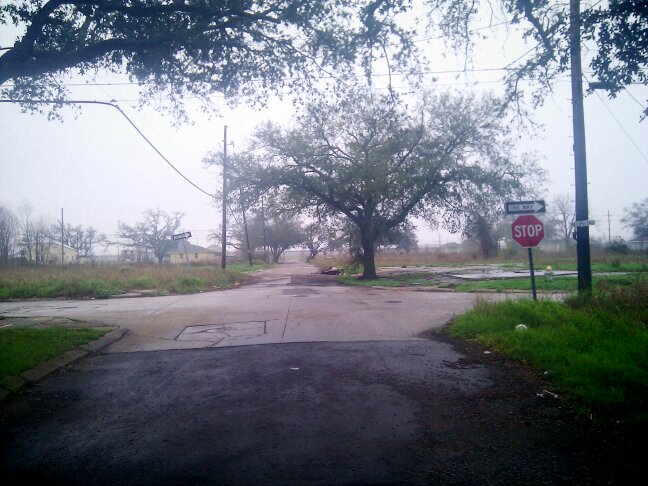
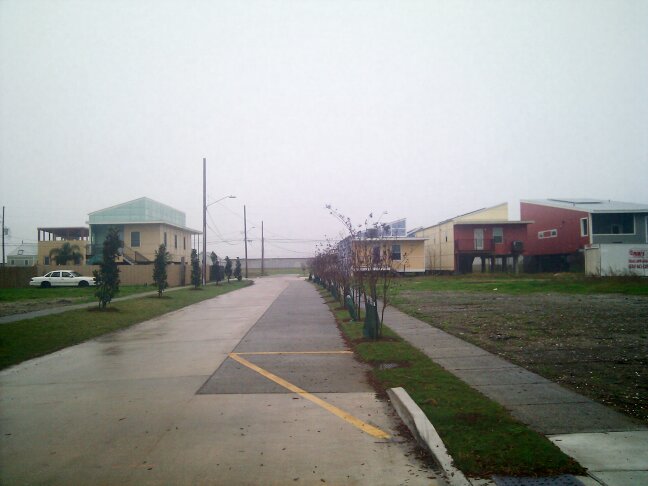
I'm writing this from 2 feet beneath sea level.  The house I am staying at was purchased last year and is currently under construction.  Outside and across the street there is one occupied home, while beside it on either side there are a few vacant lots with an abandoned house a few lots further down.  Down the road are more vacant lots, some maintained while others look like meadows or small farmers fields. Around the corner there are the Make It Right homes - futuristic-looking homes built by a post-Katrina not-for-profit.  A couple blocks further is the levee which holds back the ocean from the neighbourhood.
______________________________________________________
The Lower Ninth Ward from the levee

Living below sea level is a bit strange.  You're not able to put it fully into perspective until noticing that all houses are built on concrete slabs because if they had basements they would act more like swimming pools.  Or until you take a walk down the road and see the giant wall where the levee broke during Hurricane Katrina 8 years ago.

Post-Katrina, sections of the neighbourhood are being rebuilt in different ways.  There are the Make It Right houses (an organization headed by Brad Pitt [here we call them Brad Pitt houses]), newly constructed and affordable shotgun houses, and then there are farms.

Reminds me of Detroit!
(but with palm trees)
A lot of people argue that the Lower Ninth Ward was a food desert long before Katrina hit.  For anyone unfamiliar with the term "food desert" and how it fits into the context of the Lower Ninth, this video will give you a quick example.  When the storm went through, it took with it the remaining small grocery stores.  Today, within a 10 minute walk, there are two gas stations which mainly sell things like ready-made fried-chicken, beer, chocolate bars, and things like canned soup, peanut butter and instant oatmeal.

The other day I woke up and wanted to go out for a coffee.  While living in any other city, this has never been much of an issue for me.  Google Maps says it take 50 minutes to walk to the closest place to get a decent cup of coffee, and the closest supermarket is an 1 hour and 40 minute walk.  As in any food desert, this all means that people who can't afford to drive / are overworked and unable to make the time commitment to get to a supermarket often don't make the trip.  In turn, the food that people consume in food deserts is often lacking in nutrition and freshness - think of having instant oatmeal for breakfast, peanut butter and jam on white bleached bread for lunch, and canned soup for dinner.  No fresh fruit or veggies.

I didn't make the trip to get the cup of coffee.

A lot of people say that Katrina offered the Lower Ninth Ward an opportunity to start from the ground up, to rebuild in a way that would have the issues of the past belong only to the past.  Small farms and community gardens have popped throughout the Lower Ninth Ward because of the lack of nutritious and fresh produce nearby and abundance of vacant land since Katrina.  The produce grown usually stays in the community, giving residents greater access to food.
Brad Pitt Houses
Heather on a roof top
One of the Capstone gardens,
where I put some time in from time to time


Saturday, 23 March 2013

More on Hollygrove -- how large-scale disasters (and a bit of funding..) spur community engagement and development

A bit of a follow-up to the last post.. just found this.  Makes me wonder what the Far Rockaway in NYC will look like 8 years from now.. this video talks about how, since Hurricane Katrina, the Hollygrove neighbourhood of New Orleans has been re-envisioning and reinventing what their neighbourhood really is to themselves.  (With the help of lots of funding, of course..)

Wednesday, 20 March 2013

Work-tradin' up at the Hollygrove Farm and Market

Work-trades!  How awesome it is to be doing sustainable work for a sustainable business.  The best part is being paid in local produce. This is one farm that is located in the Hollygrove neigbourhood close to Uptown which operates as a CSA.  It's one of many farms in New Orleans which have popped up post-Katrina.


I've been heading up there every now and then for a work-trade.  What a deal -- work four hours, learn how the farm operates and get paid in local produce.   Not bad.


Friday, 15 March 2013

Farming the Lower Ninth Ward, New Orleans

I've been living in New Orleans for the past month volunteering on and off, a blogpost on my time in the Lower Ninth is to come.

Check out this video really quick -- it gives you a quick idea of what things are like here in the Lower Ninth Ward and the role of urban farming in post-Katrina New Orleans.