Sunday, 16 March 2014

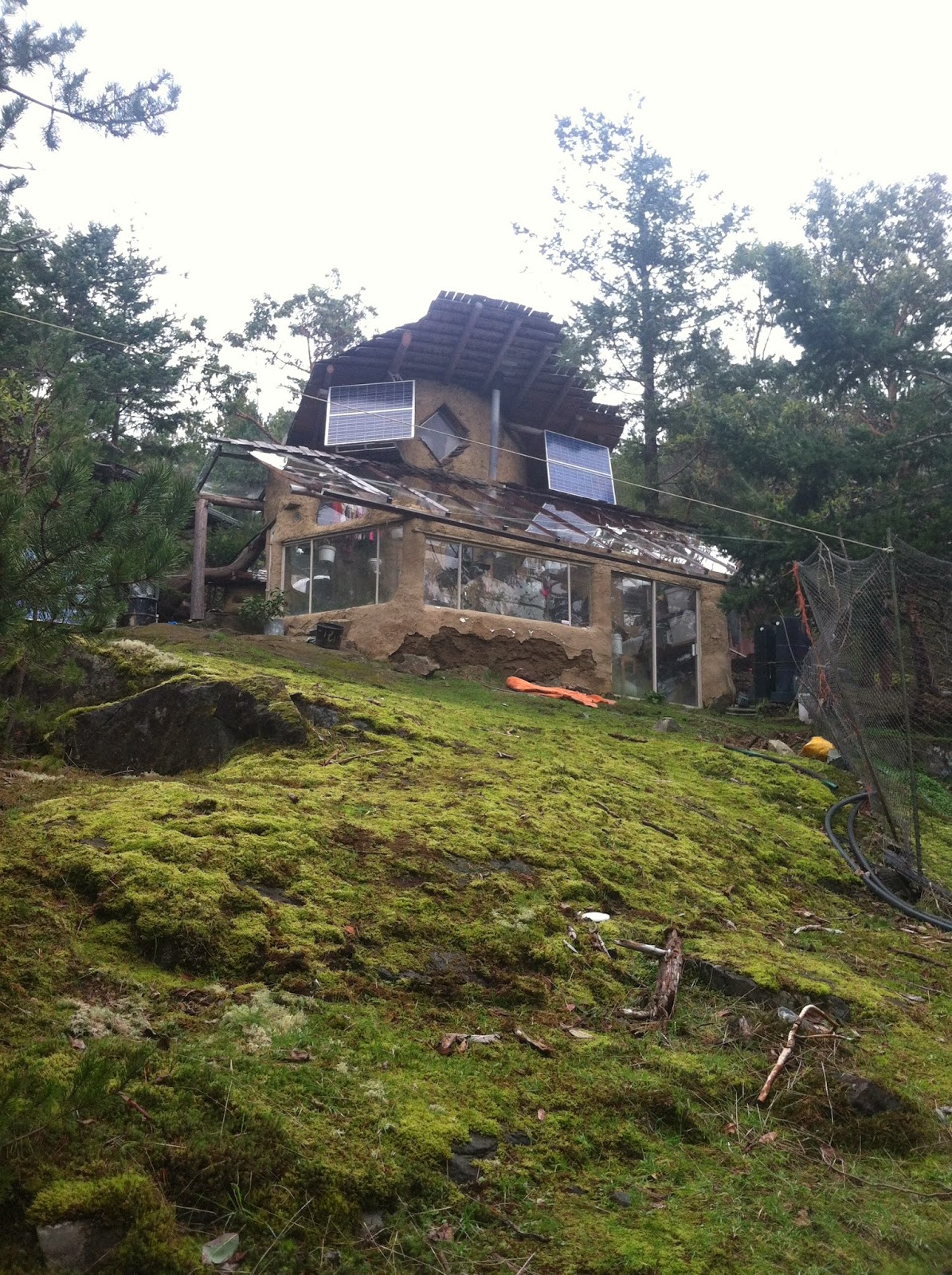
What humans can do without building codes...

Laviathan Contact Improv Dance Studio, Lasqueti Island, BC.  The owner let us poke around a little bit.


Thursday, 20 February 2014

Cob on Lasqueti Island, British Columbia

I first heard of Lasqueti Island years ago when an old friend of mine raved about how she wanted to move here after hearing stories that the whole island was off-the-grid.  I later heard that many people on the island are artists, artisans and organic farmers who trade and barder with other Lasquetian’s when buying and selling.  So when looking for permaculture and natural building communities on the BC Coast, I looked up Lasqueti.  This is what I’ve found.

Yes, it is true that Lasqueti Island is entirely off-the-grid.  Also true that the building codes are not enforced.  Also true that most homes run off of solar or micro hydroelectic power, and that there is no car-carrying ferry that goes to the island.  When BC Hydro tried to erect hydro poles to distribute electricity to the island the Islanders cut them down.  When the province tried to build a Police Station on the island it soon thereafter burned to the ground.  A beautiful, beautiful place.

But anyways, I came here to learn about permaculture and natural building.  I arrived a few weeks ago and will be here until the end of March.  Lasqueti has one of the most temperate climates in Canada.  The first day I arrived on Lasqueti it was sunny and 12 degrees Celsius.  Homes built out of natural materials (cob, straw bale) don’t require as much insulation in temperate climates which is another reason why there are so many beautiful structures built out of these materials on Lasqueti.  Shanti ended up coming out to the island and we ended up doing some cob work on Dave’s house he has been building.  Dave is building a home out of cob.


Never heard of cob?  It’s a natural building material made up of clay, straw and water.  Mix them together and you will have a strong compound to build walls out of.  It will breathe when it needs to and insulate when it needs to.  This is what the building process looked like up at Dave’s.    https://www.youtube.com/watch?v=iBWpRxzOc50&app=desktop

Tuesday, 19 November 2013

The Off Season ... And a bit of blog hiatus (but stay tuned...)

So it's been two months now since work began winding down in the Yukon.  By mid-September the snow started to fall in Beaver Creek, and I left the Yukon on October 1st for coastal BC, Washington and Oregon.

I'll be spending much of the off season putting my energy into a couple other creative projects of mine.  As such, the blog will likely not be as active as it was through the summer (surpassed 350 views for July alone!), though I do hope to keep the blogs' momentum going.  The last year has been a good one, having met some awesome people from diverse communities all over the continent, having learned something from each community.

A few of the most empowering of experiences I've had (and have chosen to write about on here) in the last year have been my posts about mutual aid and relief work in Brooklyn, NY following Hurricane Sandy last November, radical resourcefulness at the Florida Earthskills Gathering last February, and the tales of urban farming and local resilience from the Lower Ninth Ward of New Orleans last March.  If you have an hour to spare, I highly recommend reading/watching the post about Hurricane Sandy relief.

I hope to attend a primitive skills gathering over the winter, and to do a bit of farm work further south.  I'm unsure how present I'll be on the blog over the winter, but stay tuned. We're just gearin' up.



Monday, 16 September 2013

Traditional Landscaping is too 1950s.

A few shots from the summer...

Grow your own food.  Repurpose garbage.  Let your weeds grow tall. 

It looks good, and produces food and medicine for you.  And it's free.

Edible plants: Curly kale, Ornamental kale, Calendula, Nastertium, Tomato, Mint, Terragon, Basil, Thyme


Native plants: Fireweed, Yarrow, Caribou

Monday, 26 August 2013

High Latitude Gardening: Round Two (grow greens this far north!)

Fireweed, Black Spruce and direct sunlight at 10:30pm
Spinach
Green onion
Oak leaf lettuce
Green beans
Radishes
Turnips
Carrots
Cucumber
Dino kale
Curly Kale
Red Russian Kale
Beets
Alaska Peas
Swiss Chard
Celery
Tomatoes


That's what we're growin'.  While some of my stash has been going missing at the White River Community Garden on the other end of town (see last post..) the greenhouses that Rita, Randy and I grow in are doin' well.  You'd be surprised by the small amount of land needed to have a consistent harvest of greens and veggies.  We've been using about 40 square feet between two greenhouses and have been harvesting every single week.  The season is slowly winding down already (last night was the first frost) but the greenhouses are still producing.  We've been getting a consistent harvest of greens (easily enough to supply 3 - 4 people with their weekly share of greens) and Rita and Randy have been canning beets the last couple of days.  We've had too much that we've had to start giving away greens and veggies so they don't go bad.

We grew in greenhouses so we would be able to lock heat in through the nights and take advantage of the hot sun in the day, while we had it.  Leafy greens grow fast this far north.  We always have a consistent flow of kale and beet greens.  They don't mind the cooler nights (kale prefers it, actually), and you don't need to wait for hot sun to produce a flower until it begins producing the fruit (ie, our tomatoes and cucumber are struggling).  If I were further south I'd grow more tomatoes, but if you're in the north, your best bet is to grow leafy greens.  Ya won't be disappointed.

Typical early-season weekly harvest (mid-June).  Spinach, Radishes,
Radish microgreens, Spinach shoots, Dino, Curly and Red Russian Kale.
An early-July weekly harvest.
Late-July/Early August weekly harvest.
Chantelle sleeping amongst beet greens.
Indoor edible jungle, number one.